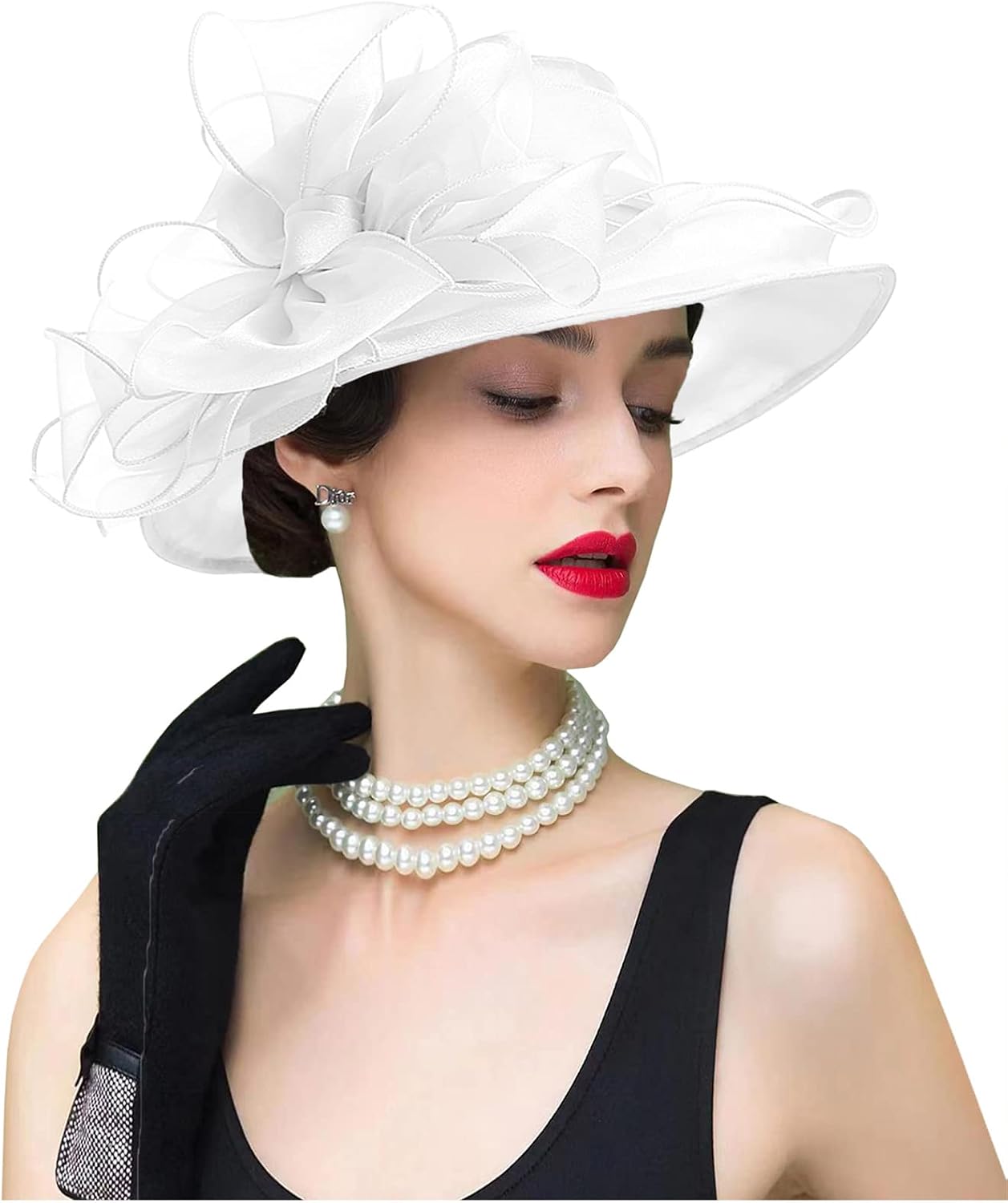
If you’ve ever stood in front of a hat display holding something gorgeous and thought, but is this too much for a garden wedding? — this article is for you. “Headwear formality” just means how dressed-up or dressed-down a hat reads relative to the event around it. A fascinator (a small, sculptural hair ornament secured with a comb or clip — not a full hat with a crown) signals something different from a wide-brim felt fedora, even if both retail for $250. Getting that signal right is the difference between looking polished and looking like you wandered in from a different party. The good news: there’s a clear framework for this, and once you see it, it’s hard to unsee. By the end of this guide you’ll be able to map any hat’s structure, scale, and material to an occasion’s actual formality level — and make the buy or the recommendation with confidence.
| EDITOR'S PICKWide Brim Church Hat for Women… | Mid-tier2026 Derby Hats for Women Ladies | Budget pickIZUS Women's Derby Sun Hat Bowk… | |
|---|---|---|---|
| Style Type | Wide brim | Sun hat | Sun hat |
| Material | — | Organza | Organza |
| Occasion | Church, wedding, tea party | Church, tea party, wedding | Church, bridal, wedding |
| Decoration | Bow | — | Bowknot |
| Size | Medium | — | Medium |
| Price | $56.90 | $37.99 | $19.99 |
| See on Amazon → | See on Amazon → | See on Amazon → |
The Formality Ladder: Four Occasion Tiers and What They Call For
Think of headwear occasions as four distinct rungs, each with its own structural logic.
Tier 1 — Ceremonial/Couture (Royal Ascot, high-church Easter, black-tie galas, couture bridal) This is the domain of Philip Treacy sculptural pieces, Maison Michel hand-blocked toppers, and bespoke sinamay constructions from independent milliners. Sinamay is a woven fiber made from the abacá plant — stiff, lightweight, and capable of holding dramatic angles without internal structure. At this tier, the hat is the outfit statement. Scale can be extreme. Per Town & Country’s 2025 Royal Ascot style breakdown, the dress code explicitly requires that headpieces measure at least four inches in diameter — a rule designed to distinguish occasion millinery from everyday accessories. Budget reality: meaningful pieces at this tier start around $400–$600 and climb well past $1,200 for bespoke commissions.
Tier 2 — Dressy Occasion (Kentucky Derby, mother-of-the-bride, formal church service, afternoon wedding) The widest and most commercially active tier. This is where the church hat tradition lives in full force — and where most buyers at the $150–$500 range are shopping. Harper’s Bazaar’s 2023 piece on church hat culture notes that the Black American church hat tradition, documented extensively by Smithsonian Magazine as a practice rooted in post-Emancipation expressions of dignity and self-determination, values exactly the qualities that make a hat legible from a pew: deliberate scale, color authority, and structural confidence. A hat that reads at distance. For non-church occasions at this tier, the same logic applies: you want a silhouette with intention, not an accessory that disappears.
Tier 3 — Smart Casual/Garden Party (outdoor wedding reception, bridal shower, Derby watch party) Sun hats and relaxed wide-brims belong here — Parisisal straw (a fine, hand-woven palm fiber prized for its smooth surface and flexibility), packable raffia, and lighter-weight felt. Eric Javits and Lack of Color operate comfortably in this register. The hat should feel like it belongs to the outfit, not competing with it. A fascinator can work if the event leans dressed-up; a broad-brim parisisal works if it leans garden-party.
Tier 4 — Casual (outdoor picnic, beach wedding, street-style) Straw hats, baseball caps elevated with fabric, casual felt. At this tier, headwear is sun protection and aesthetic choice, not occasion signaling. The $28–$80 entry market lives here.
Structure Is the Variable That Actually Matters
Price is not the clearest signal of formality. Structure is. Here’s the decision frame that experienced buyers use:
Hard structure — hats that hold their shape independent of the wearer (blocked felt, stiffened sinamay, wire-framed fascinators) — read as more formal. They require intention to wear and communicate that intention back to the room. A fur felt fedora from Gladys Tamez, hand-blocked over a wooden form, telegraphs formality not because of its price tag but because of its deliberate geometry.
Soft structure — hats that drape, flop, or flex (raffia, unblocked straw, loosely woven sun hats) — read as more relaxed. Even an expensive raffia hat from a luxury brand reads lower on the formality ladder than a mid-priced blocked felt piece.
Scale and brim width operate as a secondary dial. Wider brims read more dramatic, which can mean either more formal (if the material and construction are elevated) or more casual (if the material is relaxed straw and the setting is outdoors). This is the nuance that trips up intermediate buyers: a 5-inch brim in parisisal straw reads garden-party at a lawn reception and completely appropriate at Tier 2 if the straw is fine-woven, the trim is architectural, and the event has color in the dress code.
By the numbers:
- Fascinator / hatinator (comb-mounted, under 4 inches): Tier 1–2, indoor or covered-outdoor
- Blocked felt or sinamay, 3–5 inch brim: Tier 1–2, any setting
- Fine parisisal or sewn straw, 4–6 inch brim: Tier 2–3, outdoor preferred
- Packable raffia or paper straw, any brim: Tier 3–4 only
Church Hat Buying Decisions: Where the Tradeoffs Live
If you’re buying or recommending a church hat — whether for yourself, a client, or a mother-of-the-bride situation — the decision points are more specific than general hat buying, and the stakes are higher. Church hat culture, as Smithsonian Magazine’s documentation of the tradition makes clear, carries weight beyond fashion: these hats are community statements worn to be seen and admired at close range over multiple seasons. That changes the calculus.
Color confidence over neutrality. The instinct to play it safe in black or ivory often produces a hat that reads as an afterthought in a church context. Jewel tones, bold brims in unexpected colors, and statement trims are the correct register here. If a client is hesitant, point her toward The Cut’s 2024 wedding guest hat piece, which explicitly names “going bigger and more chromatic than you think is polite” as the correct approach for occasions where hat-wearing is culturally expected.
Blocking quality over embellishment. A well-blocked hat — meaning the crown and brim were shaped over a wooden or aluminum form under heat and moisture, then allowed to set — will hold its silhouette through a three-hour service and a reception. An unblocked or lightly stiffened hat will wilt. Buyers in the $200–$400 range often find that independent milliners (many of whom specialize in exactly this tradition and can be found via the Millinery Association of Australia’s directory or through Hat Life magazine’s maker database, both accessible by name-search) produce more durably blocked work than some mass-market designer labels at similar prices.
Fit is a non-negotiable at this tier. A church hat is worn for hours. The standard millinery sizing runs on head circumference in inches or centimeters; most adult women fall between 21.5 and 23 inches. A hat that’s a quarter-inch too small creates pressure headaches; too large, and it shifts with movement. Many buyers in this segment underestimate how much custom sizing matters — bespoke or semi-bespoke commissions from makers like Eugenia Kim’s custom line or regional milliners allow for this in a way off-the-shelf buying often doesn’t.
Wedding Guest Headwear: The Decision Frame
Wedding guest headwear has a different set of constraints than church headwear. The occasion is singular, the dress code may be explicit or implied, and the hat must work in photographs alongside multiple other people.
Vogue’s 2024 wedding guest dress code guide identifies the most common failure mode: guests who wear headwear appropriate to the hat’s price point rather than the event’s actual formality. A $600 Philip Treacy fascinator worn to a casual outdoor garden ceremony reads as overcalibrated; a $95 packable straw worn to a formal cathedral wedding reads as underdressed even if the hat itself is attractive.
The decision rule, stated plainly:
-
If the ceremony is indoors and the dress code is formal or black-tie adjacent: structured blocked headwear, fascinator, or hatinator. Scale can be expressive but shouldn’t obstruct sightlines in pews or theater-style seating (a practical note: very wide brims — over 6 inches — are generally a courtesy issue in seated indoor settings).
-
If the ceremony is outdoors and the dress code is garden party or cocktail attire: fine straw, parisisal, or felt in proportion to the outfit. This is the most permissive tier for personal style.
-
If the dress code says “festive attire,” “Derby-inspired,” or “church Sunday best”: this is an explicit invitation for Tier 2 hat energy. Go chromatic, go structured, go deliberate.
-
If there’s no dress code signal at all: default to a hat that is one increment more dressed than you think the average guest will be. Wedding guest headwear reads as a contribution to the visual occasion; arriving over-hatted is almost always better received than arriving under-hatted, particularly in communities where hat-wearing is expected.
The Price Ladder, Honestly Assessed
One question practitioners get regularly: when does spending $500 on a church or wedding hat actually buy you something a $150 hat can’t deliver?
The honest answer has two parts. In blocked felt — fur felt in particular, graded by the percentage of beaver or rabbit content — the difference between a $150 hat and a $500 hat is almost always material quality and hand-finishing. Higher fur-felt grade means a smoother surface, more saturated dye uptake, and better shape retention across seasons. Reviewers and longtime wearers consistently note that quality fur felt, properly stored, holds its block for decades. That’s a real cost-per-use argument.
In sinamay and straw constructions, the premium at $400–$600+ is more often about designer attribution, trim elaboration, and couture-adjacent construction detail than material alone. A skilled regional milliner working in quality sinamay can produce structurally equivalent work at $200–$350. The premium above that buys provenance, label recognition, and in some cases, collectibility — all legitimate reasons to pay, but distinct from pure functional performance.
If you’re dressing for a single occasion: the $150–$250 range from a quality domestic or imported brand covers the functional brief completely.
If you’re building a hat wardrobe or buying for a client who will wear this piece across multiple high-visibility occasions: the $300–$600 range, particularly from independent milliners who offer fitting and custom blocking, delivers meaningfully better long-term value.
If the occasion is genuinely once-in-a-generation — a royal garden party, a prominent race day, a significant family event that will be photographed and remembered: the couture tier is a reasonable decision, not an indulgence. The hat is doing work that no other accessory can do.